You're about to create your best presentation ever

Presentation Night Poster Template

Create your presentation by reusing one of our great community templates.

Presentation Poster Template

Transcript: Presentation Poster Template A Comprehensive Guide to Creating Engaging Presentation Posters Introduction to Poster Presentation A poster presentation is a visual communication tool used to convey information about a specific topic, research, or project. It serves as a vital method for sharing ideas and findings in academic and professional environments, allowing for engagement and discussion with the audience. "Questions are the engines of intellect." The Importance of Questions Title Abstract The abstract summarizes the key points of the research, providing a snapshot of the study's purpose, methods, results, and conclusion in a brief format. A concise and descriptive title serves as the first impression of your poster, capturing the essence of the research and engaging the audience's interest. Conclusion and Best Practices Introduction Methods Key Components of a Poster The introduction provides necessary background information that sets the context for the research, outlining its significance and objectives. The methods section details the approach and procedures followed during the research, allowing others to understand and replicate the study. Results Conclusion Creating an impactful poster presentation requires attention to both content and design. By focusing on essential elements and following best practices, presenters can effectively communicate their research and engage their audience. The results section highlights key findings, often using graphs, charts, or images for visual representation to make data easily digestible. The conclusion summarizes the main findings, discussing their implications and significance, and often suggests areas for future research. Overloading with text Poor image quality Common Mistakes to Avoid Inconsistent formatting Utilize ample white space Ignoring audience engagement Design Tips for Effective Posters Incorporate visual hierarchy Select appropriate fonts Limit color palette Use bullet points strategically

Mini-Poster Template

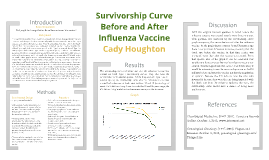
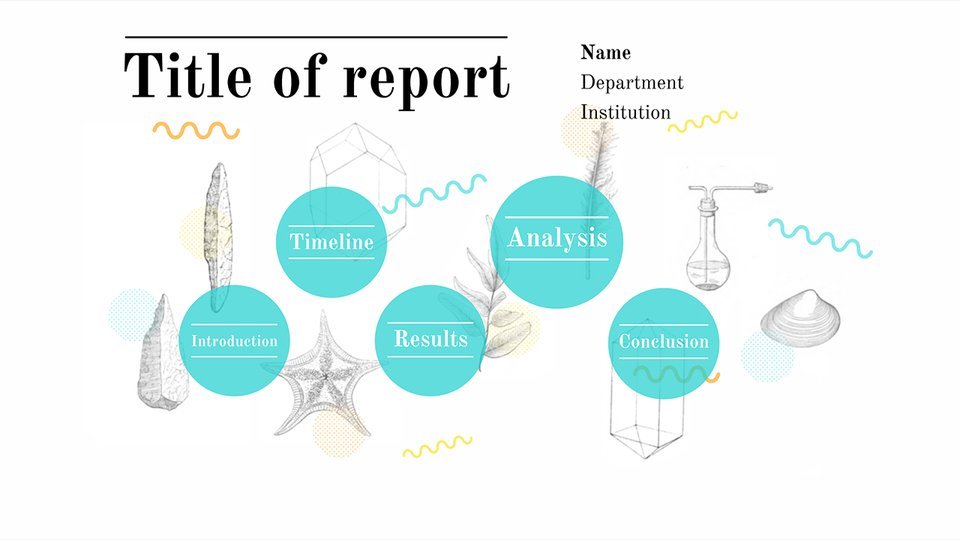
Transcript: Survivorship Curve Before and After Influenza Vaccine Cady Houghton Procedure Background Experimental Design Methods Research Question 1) A data base of cemeteries was looked up to find death dates and information. 2) From the data base information was put into a google drive document. 3) 40 people dying before the 1945 influenza vaccine were put into one chart showing the ages of death. 4) 40 people dying after the 1945 influenza vaccine were put into another chart also showing ages of death. 5) Both charts of groups of people were converted into a life history table. 6) From each life history table the data was put into another chart to make two survivorship curve charts. 7) The survivorship curve charts were put into one survivorship curve chart to show the difference in curves. A laptop was used for this lab. If the influenza vaccine works then if we compare the survivorship curve of before and after the vaccine it will show people living longer because the vaccine will be decreasing the death rate. The independent variable in this experiment is the influenza vaccine. The dependent variable is the death rate in this experiment. The exponential variables in this experiment are the other disease epidemics during the time period the data was chosen from. The control is the survivorship curve before the influenza vaccine and the experimental is the survivorship curve after the influenza vaccine. The survivorship curves of before and after the influenza vaccine was created are both Type I survivorship curves. They also have the caracteristics for K-selected species. While they are both Type I and K-selected species, the survivorship curve after the influenza vaccine was created had a decrease in death rates between 20 and 70 years of age of about .5 #/1,000 surviving. Then, towards the 75 and 90 years range, the #/1000 surviving leveled out and became extremely similar in curves. Did people die younger before the influenza vaccine was created? In comparing survivorship curves a Log10 scale is used for its ability to show you greater numbers in a more readable way and to show same mortality with the same curve when two scales are put together. In a Log10 scale there are three Types of information. The first, Type 1, are mainly humans. Type I survivorship curves are characterized by high survival in early and middle life, followed by a rapid decline in survivorship in later life. Type 2 is mainly birds and Type 3 is mainly reptiles. Within these Types are two categories of species, K-Selected, or Equilibrium, species and R-Selected, or Opportunist, species. K-Selected species usually have stable resources and a stable environment, and this is usually what humans are categorized as. R-Selected species are usually whose population size tends to fluctuate greatly in reaction to variations in the environment. Comparing the survivorship curves, defined as a graph showing the number or proportion of individuals surviving at each age for a given species or group cohort, before and after the influenza vaccine was created will show if the vaccine helped increase the population. Before the 1940s when the influenza vaccine was created, the epidemic was particularly deadly in US Army training camps, where the death rate was as high as 80% in some camps. Death rate is usually calculated as the number of deaths per one thousand people per year. usually calculated as the number of deaths per one thousand people per year. The US military was getting hit with influenza the most forcing them to developed the first approved vaccine for influenza, which was used in the Second World War. Studying this specific survivorship curve will also help to tell if their were more survival rates in the US military during the time. Results With the original research question in mind, before the influenza vaccine was created people were dying younger. This question was answered by the survivorship curve graph comparing the curves before and after the influenza vaccine. As the graph shows between 20 and 70 years of age there is a significant difference in curves, meaning that the death rate before the vaccine in that time period was increased more than after the vaccine was created. From that specific area of the graph it can be concluded that people were dying younger before the influenza vaccine was created, thus the hypothesis was correct. For future study it would be interesting to see the survivorship curve in the US military before and after the vaccine not just the population in general. Because the US military was the one who invented it because they were the one being impacted with the death rate from the influenza epidemic the most, the survivorship curve would have a chance of being more predominant. Graph Clear Digital Media, Inc. (1997-2011). Cemetery Records Online. October 1, 2013, www.interment.net Genealogical Gleanings. (1997-2004). Plagues and Diseases. October 3, 2013, genealogical-gleanings.com/Plauges.htm Introduction

Poster Template Design

Transcript: Introducing the 70x140 cm Poster Template This presentation outlines the features of a poster template specifically designed in the dimensions of 70x140 cm, focusing on its purpose and the advantages it offers for effective communication in various contexts. Enhanced Visibility The 70x140 cm size ensures that the content is easily readable from a distance, making it perfect for crowded environments like exhibitions and conferences. Optimal Size Key Benefits of 70x140 cm Size This size strikes a balance between large enough to attract attention and small enough for easy transportation, making it versatile for various uses. Effective Layout The dimensions allow for effective layout of textual and visual elements, facilitating better audience engagement and comprehension of the information presented. Poster Template Design Design Elements Engaging Visuals Concise Text Strong Headline Engaging visuals such as images or graphics enhance understanding and retention of information. Concise text ensures clarity and allows viewers to quickly understand the key points without overwhelming them. A strong headline grabs immediate attention and conveys the main message effectively. Creating an Effective 70x140 cm Presentation Poster Marketing Events Academic Presentations In marketing events, the same template serves to highlight product features, promotional messages, and branding elements. Its size ensures that key visuals and texts attract potential customers' attention, creating an engaging display. The poster template is highly effective for academic presentations, where it can showcase research findings, data, and scholarly insights. This size allows for detailed graphs and text that cater to an academic audience. Evolution of the 70x140 cm Poster Template Tracking the development and versatility of the poster template across different applications and fields. Marketing Adoption Current Trends Initial Design The template began to see broader applications in marketing events, adapting to the needs of showcasing products. Modern iterations of the template now incorporate digital elements and interactive features to enhance communication. The 70x140 cm poster template was first introduced, focusing on basic design principles for academic use. Enhanced Features Future Directions The template was updated to include engaging visuals and layout adjustments to improve audience engagement. Looking ahead, the template is expected to evolve with trends in design and technology, catering to diverse fields.

Scientific Poster Template

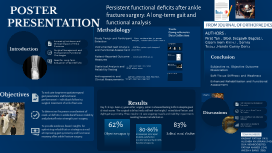
Transcript: Persistent functional deficits after ankle fracture surgery: A long-term gait and functional analysis POSTER PRESENTATION Tools: Comprehensive Data Collection Methodology - Cross-sectional design, power analysis, inclusion/exclusion criteria Study Design and Participant Selection Increasing Incidence and Clinical Impact of Ankle Fractures Conclusion Fracture Classification & surgical Distribution Lateral malleolars Bimalleolars - seven individual -two individual -three individual Trimalleolars Introduction Instrumented Gait Analysis and Functional Assessment - GAITRite system, spatiotemporal parameters Surgical Management and Postoperative Functional Challenges Fracture Pattern Analysis - AOFAS and OMAS scales Patient-Reported Outcome Measures Denis-Weber Classification -Majority of participants (n=13) had Type B fractures, with only one classified as Type C. Lauge-Hansen Classification -Thirteen cases were identified as supination-external rotation injuries, and one as supination-adduction.. Need for Long-Term Evaluation of Gait Deficits Subjective vs. Objective Outcome Dissociation Soft Tissue Stiffness and Weakness Enhanced Rehabilitation and Functional Assessment Functional and Clinical Assessment - Wilcoxon test, ICC, SEM, MDC, effect sizes Heel Rise Test – plantarflexor strength Weight-Bearing Lunge Test – ankle dorsiflexion mobility GAITRite System – spatiotemporal gait parameters AOFAS Ankle-Hindfoot Scale – patient-reported outcome Olerud-Molander Ankle Score (OMAS) – patient reported outcome Statistical Analysis and Reliability Testing Summary Table Finding Category Parameter Surgical Non-Surgical Ratio Deficit Gait Step Length 58.0 cm 55.7 cm 1.04:1 +4% Gait Double 0.3 s 0.4 s 0.75:1 -25% Function Heel Rise 9.7 cm 11.4 cm 0.85:1 -15% Function WBLT 4.0 cm 10.5 cm 0.38:1 -62% Function WBLT 6.5 cm 1.5 cm 4.3:1 +333% Subjective AOFAS 86.5/100 - 86.5% - Subjective OMAS 80/100 - 80% - - Calf circumference, Heel Rise Test, Weight-Bearing Lunge Test Anthropometric and Clinical Measurements Paradox Objective 62% 83% Gap: 21%- vs Subjective Objectives Results To evaluate long-term spatiotemporal gait parameters and functional performance in individuals following surgical treatment of ankle fractures. THANK YOU Key findings :Even 4.5 years after surgery, patients showed lasting deficits despite good clinical scores. The surgical side had reduced heel-rise height, limited dorsiflexion, and slight gait asymmetry. These results indicate ongoing muscle and mobility impairments needing focused rehabilitation. Gait Compensatory Strategies and Asymmetry To determine the presence and extent of residual deficits in ankle dorsiflexion mobility and plantarflexion strength post-surgery. Gastrocnemius-Soleus Complex Dysfunction Discussions 62% 83% Ankle Dorsiflexion Limitations and StiffnessC. 80-86% Objective capacity Subjective satisfaction Clinical Scores vs. Functional Performance Gap To provide evidence-based insights for optimizing rehabilitation strategies aimed at improving gait symmetry and functional recovery after ankle fracture surgery. Increase patients report 80-86% satisfaction despite having only 38-85% functional capacity

Scientific Poster Template

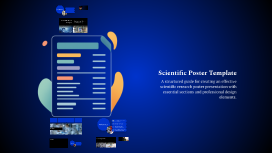
Transcript: Objectives Standardize poster presentation format Identify essential poster elements Clear poster presentation template. Enhance visual communication effectiveness Introduction Enhances communication of research. Facilitates audience understanding. Scientific Poster Template This template serves as a guideline for creating effective scientific posters for academic conferences. It includes essential sections that enhance clarity and communication of research findings. Scientific Poster Template A structured guide for creating an effective scientific research poster presentation with essential sections and professional design elements. Study Design: Descriptive Research Tools: Surveys and Software Sample Size: To Be Determined Variables: Independent and Dependent Smith, J. (2020). Understanding Scientific Posters. This study employs a descriptive research design, which is ideal for providing a clear overview of the phenomena without manipulating variables. The sample size will be determined based on the objectives of the study, ensuring it is representative of the population being studied. Variables will include key factors relevant to the study's objectives, categorized into independent and dependent variables for clear analysis. Tools used for data collection may include surveys, questionnaires, and analytical software to ensure accurate results and analysis. Johnson, L. & Lee, M. (2019). Effective Poster Design Techniques. References Taylor, R. (2021). Visual Communication in Science. Methods Green, A. (2018). The Importance of Structure in Presentations. Disclosures Acknowledgements Results We extend our heartfelt gratitude to all the contributors, mentors, and institutions that provided invaluable support throughout this research project. Your guidance and resources were essential in bringing this work to fruition. This section outlines any potential conflicts of interest related to the research. It's essential for maintaining transparency and integrity in scientific communication. The study yielded significant findings pertaining to participant satisfaction and engagement levels. Key findings summarized effectively Conclusion Future research implications outlined 80% 5% 15% Next steps for studies identified Overall Satisfaction Rate Reduction in Errors Increase in Engagement

Now you can make any subject more engaging and memorable