You're about to create your best presentation ever

Free Career Development Powerpoint Template

Create your presentation by reusing a template from our community or transition your PowerPoint deck into a visually compelling Prezi presentation.

Development Powerpoint

Transcript: KINDERGARTEN Piaget: In kindergarten we did a lot of adding using blocks or other objects. This shows the preoperational stage in action. The intelligence is demonstrated through symbols (the blocks representing the numbers). FIRST GRADE Gilligan: We used to play lava monster on the playground. I would never want to be the monster and usually more boys ended up wanting to be the monster than girls. This shows Gilligan's belief that girls grow up with a sense of nurturing. Girls normally do not want to cause pain to others which is why they would rather be chased and not be the monster. SECOND GRADE Erikson: In second grade my cousin and I snuck away at a block party in order to ride a hayride that our parents wouldn't let us do. I remember after sneaking away from the block party feeling some remorse for doing something that I wasn't supposed to do but the feeling of adventure overpowered that. THIRD GRADE Mead: In third grade our teacher made our classroom live by the golden rule. This is the basis of Mead's theory. This rule was drilled into be back in third grade and still sits with me and most of my friends to this day. FOURTH GRADE Cooley: Fourth grade was the first year that I really remember caring what other people thought of me. I began to wonder how other people viewed me and started to dress and act accordingly. It was the first year I started to worry about fitting in. FIFTH GRADE Piaget: In fifth grade we started using some algebra type math and also began reading critically which shows that by then most of us had reached the Concrete thinking phase. We were able to begin thinking bastractly to solve problems. SIXTH GRADE Kohlberg: This was the year that our class took a trip to Nature's Classroom. It was the first time that I had been away from my parents for an extended period of time. There were new rules and we had more rights and freedom then ever before. It taught us how to adjust to a completley new lifestyle for a few days. SEVENTH GRADE Erikson: Seventh grade was a new experiance for everyone. We were meshed together with a bunch of strangers that we didn't know. We had to meet new people and re - organize our social groups. This is a perfect example of Erikson's fifth step, identity vs. role confusion. We were all trying to fit in and find groups that made us feel like we belonged. I began to do things for myself and what others around me thought rather than my parents. EIGHTH GRADE Cooley: Yet, again I began to worry how others saw me. I began to dress in all brand named clothes and constantly thought about how other people viewed me. I got paranoid worrying about what other people thought and began to act different and change myself in order to fit in, hoping that people saw me in a good light. NINTH GRADE Piaget: In ninth grade all learning in school took the path of Formal thinking. We began to pick apart literature and find the deeper meanings in everything that we did. I was at the point where I began to be able to think like this and act accordingly. TENTH GRADE Gilligan: I began to pick relationships carefully in order to avoid being hurt. I took great care in my friendships and when something went wrong, I would be crushed. This again shows how Gilligan that girls were brought up with a natural nurturing and caring ability. ELEVENTH GRADE Erikson: This year I had a serious boyfriend that I had been going out with for over a year. This goes along with Erikson's idea on intimacy vs. isolation. I put all of my time into my boyfriend and had began to make a long term relationship out of it. I learned how to give my time to someone and share my feelings with someone. SENIOR YEAR Erikson This year I broke up with my boyfriend and I went back to identity vs. role confusion. I had to meet new friends and reconnect with my old ones in order to help get rid of that lonely feeling that I was experiancing. It was confusing and hard to do at first but everything turned out okay.

Free Coral Reef PowerPoint Template

Transcript: Understanding Coral Reefs: The Rainforests of the Sea Coral reefs represent some of the most vibrant and biologically diverse ecosystems on the planet. Composed of calcium carbonate structures built by coral polyps, these underwater formations are essential for marine life and play a crucial role in ocean health. Their rich biodiversity supports countless species, making them vital to both ecological balance and human activities. Habitat for Marine Life Coral reefs serve as essential habitats for a vast array of marine species, including fish, invertebrates, and algae, supporting biodiversity and complex food webs. Coastline Protection Coral reefs protect coastlines by absorbing wave energy, reducing the impact of storms and preventing erosion, thus safeguarding coastal communities. Importance of Coral Reefs Support for Fishing Industries The fishing industry relies on healthy coral reefs for sustainable fish populations, which are crucial for food security and local economies. Contribution to Tourism Coral reefs attract millions of tourists each year, providing opportunities for recreation, education, and research, which boosts local economies. Biodiversity Hotspots Coral reefs support approximately 25% of all marine species, providing critical habitat and food sources for countless organisms. Economic Significance Conclusion The economic value of coral reefs is estimated to be over $375 billion annually, contributing to fisheries, tourism, and coastal protection. Conservation Importance Effective conservation strategies can help restore damaged reefs and enhance their resilience against climate change, ensuring their survival for future generations. Free Coral Reef PowerPoint Template A visually striking template designed for presentations on coral reefs and marine conservation. Utilizing the Coral Reef Presentation Template This template provides a structured approach to effectively communicate the importance of coral reefs. It features dedicated sections for essential facts, visuals, and timelines, making it easier to convey complex information clearly and engagingly. Timeline of Coral Reef Conservation Efforts Key initiatives and milestones in preserving coral ecosystems. Effects of Pollution and Overfishing Impact of Climate Change In addition to climate change, pollution from land runoff introduces harmful chemicals and sediment into marine environments, smothering corals and disrupting their delicate ecosystems. Overfishing and destructive fishing methods further exacerbate the decline of reef health, leading to imbalances in marine biodiversity. Coral reefs are increasingly endangered due to climate change, which causes rising ocean temperatures and leads to coral bleaching. This phenomenon occurs when stressed corals expel the algae living in their tissues, resulting in a loss of color and critical energy sources. 1990 2010 2020 2000 The establishment of the first marine protected areas to safeguard critical reef habitats. International agreements and partnerships formed to combat overfishing and promote sustainable practices. Restoration projects initiated to rehabilitate damaged coral reefs affected by bleaching events. Emergence of citizen science programs that engage local communities in coral monitoring and conservation efforts.

Career template

Transcript: Singers By Izzy Leas / 4th What is a singer? A singer is someone who uses their voice to produce music. They sing on stage, radio, T.V., or videos. Description Responsibilities? What are their responsibilities? To memorize musical selections and routines. Perform live audiences, or in T.V., radio, or movie productions. Learn acting, dancing, and other skills Practice singing exercises and study with vocal coaches, in order to develop their voices and skills and to rehearse for upcoming roles Collaborate with a manager or agent who handles administrative details, finds work, and negotiates contracts What classes do you need to take to be a Singer? Education There are different kind of singers. Like Opera Singers has to have a bachelors degree, but a regular singer doesn't have a requirement that is interested in being a singer. What skills do you need? To be a singer you need to have a musical talent, whether or not you like to play an instrument or just sing. Skills More skills What is the salary and benefits? Salary & Benefits Salary: The median hourly wage for musicians and singers was $30.39 in May 2019 The lowest 10 percent earned less than $11.11, and the highest 10 percent earned more than $80.70 Benefits: Singing makes you feel energized an uplifted. People who sing healthier than people who don't. Benefits Pros and Cons Benefits & Drawbacks Pros: You can travel the world. Having fans that will support you through anything and everything Making money! Cons Cons: Obsessive fans will stalk you Missing distant family members having a hoarse voice from singing and talking too much. It hurt's your throat after a while Cons What is the outlook of a singer? Outlook & Forecast Conclusion

Career Powerpoint

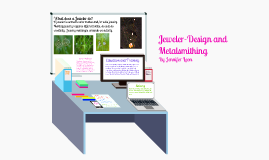
Transcript: Jeweler-Design and Metalsmithing A jeweler's work environment consists of their studio and work bench. A work bench has basic tools such as pliers, files, hammers, and polishing materials. By Jennifer Leon For two years now, I have been making jewelry and I have my own business. I sell at 5 different stores on Kauai and I am really passionate about my work. I have plans to expand my business and education so that I can continue to do what I love. Salary Sketches Depending on what type of jewelry you're planning to make, most jewelers will first come up with a sketch of their design before they create their piece. Career Pathway A jeweler is someone who makes and/or sells jewelry. Making jewelry requires different skills, as well as creativity. Jewelry making is a hands-on activity. What does a Jeweler do? -Photos from slide 2: Jennifer Leon, Jewelry By Jen. -Career pathway information: Fashion Institute of Design and Merchandising (FIDM), www.fidm.edu -Wikipedia, jeweler: www.wikipedia.com Next step is making the piece! Wire wrapping, soldering, beading and polishing are all techniques used to create earrings, bracelets, necklaces, and rings. Depending on the type of jewelery being sold and how much is produced, a single jeweler can earn a range of $35,000-$95,000 each year. To become a jewelry designer, certain art colleges offer one or two year courses in Jewelry Design, metalworking, and/or gemology. You can receive a degree in Associate of Arts, Associate of Arts- Professional Designation, Metalworking, or Gemology. If you plan to start your own business, you will also need a Bachelor of Science Degree in Business Management. A jewelery designer would be apart of a fashion merchandising pathway. You can start in the industry as an intern, jeweler's assistant, then (with education) work up to a jewelry maker and metalsmith, then a designer, then a business owner or co-owner. Why I chose this career Work Space Bibliography Jewelry Making Hours and schedules usually depend on the jeweler. It is a flexible career. Education and Training

Now you can make any subject more engaging and memorable