You're about to create your best presentation ever

Hough Business Powerpoint Template

Create your presentation by reusing a template from our community or transition your PowerPoint deck into a visually compelling Prezi presentation.

Medical PowerPoint Template

Transcript: Medical PowerPoint Template Design Elements Color Schemes for Medical Presentations Font Selection for Readability Color schemes significantly affect audience understanding and retention. In medical presentations, using blue and green hues promotes calmness and trust, while contrasting colors can highlight key information and enhance visibility. Choosing the right font is crucial for comprehension. Sans-serif fonts like Arial or Helvetica are recommended as they are easier to read on screens. Always ensure that text is large enough to be legible from a distance. Incorporating Graphics and Images Layout and Structure Incorporating relevant graphics can enhance understanding and retention of complex ideas. Use high-quality images, charts, or diagrams that directly relate to the content to support the narrative without overcrowding the slide. A well-structured layout guides the audience’s eye and improves information flow. Utilize a grid system to maintain alignment and consistency, making sure to reserve space for visual elements. Balance text with images to avoid clutter. A Blank Canvas for Your Data Presentation Tips Best Practices for Delivery Content Organization in Medical Presentations Engaging Your Audience Practicing your presentation can lead to smoother delivery and reduced anxiety. Utilize appropriate body language, voice modulation, and eye contact to foster a connection with the audience, making your message more impactful. Audience engagement is critical for effective communication. Techniques include asking rhetorical questions, using relatable examples, and incorporating multimedia elements to maintain interest and encourage participation. Title Slides and Headings Introduction to Medical Presentations Title slides set the stage for your presentation and should include the topic, your name, and the date. Headings throughout the presentation guide the audience through the narrative and facilitate smooth transitions between topics, ensuring clarity and focus on key messages. Bullet Points vs. Paragraphs Handling Questions and Feedback Bullet points provide concise and digestible pieces of information, making it easier for the audience to follow along. In contrast, paragraphs may be necessary for complex concepts but should be used sparingly to maintain attention and avoid overwhelming the viewer. Practicing and Timing Your Presentation Using Tables and Charts Tables and charts effectively present quantitative data, making complex information more approachable. They facilitate quick understanding of trends and relationships within data, enhancing the audience’s ability to interpret clinical findings or statistical results. Rehearse your presentation multiple times to refine your delivery and timing. Understanding how long each section takes helps ensure that you cover all material without rushing or exceeding your allotted time. Encourage questions to create a dialogue with your audience. Responding thoughtfully to feedback shows respect for their input and enhances clarity for everyone involved, improving overall comprehension. Citing Sources and References Importance of Visual Aids Citing sources is crucial in maintaining credibility and allowing the audience to explore further. Proper referencing not only attributes the original work but also strengthens arguments presented in the medical content, supporting evidence-based practice. Visual aids play a crucial role in medical presentations by simplifying complex information. They help audiences grasp essential concepts quickly, improving retention and engagement through the use of charts, images, and videos. Overview of PowerPoint Features PowerPoint offers various features to enhance medical presentations, including templates specifically designed for medical content, the ability to incorporate multimedia, and options for animations that can illustrate processes or changes over time. Objectives of the Medical Template The medical PowerPoint template serves to streamline the creation of presentations by providing a standardized format. This ensures consistency in design and aids users in organizing their data effectively for clarity and impact.

Modern Business PowerPoint Template

Transcript: Best Practices for Business Presentations Implementing effective strategies to enhance presentation impact. Ongoing Maintain slide conciseness by limiting text and focusing on key messages. Final Thoughts and Customization This modern business PowerPoint template serves as a versatile framework that can enhance your presentations. The next steps include tailoring the template to reflect your brand's identity through color customization and layout adjustments, ensuring it meets your specific business needs. Use High-Quality Images Images should be high-quality and relevant to the topic to create a professional appearance and enhance understanding. Incorporate Meaningful Icons Incorporating Visual Elements Icons can simplify complex information and serve as visual cues to guide the audience through key points. Utilize Data Visualizations Charts and graphs can effectively convey data in a visually appealing way, making it easier for the audience to interpret and retain information. Modern Business PowerPoint Template Exploring a Sleek and Contemporary PowerPoint Template Design for Businesses Importance of Typography in Business Presentations Typography plays a vital role in ensuring readability and conveying brand identity. This template features contemporary font selections that enhance clarity and complement the chosen color palette, creating a cohesive look throughout the presentation. Introducing a Modern Business PowerPoint Template Text-Heavy Slides Image-Focused Slides Vibrant Teal: #00a180 Dark Gray: #313233 The primary color #00a180 is a vibrant teal, ideal for accents and highlights. It conveys freshness and modernity, making it suitable for business presentations. The dark gray #313233 serves as a strong background or text color, providing excellent contrast for readability and a professional appearance. The template provides a variety of slide layouts designed to cater to different content needs. Text-heavy slides focus on delivering detailed information clearly, while image-focused slides highlight visuals to enhance engagement. Comparison slides allow for direct juxtaposition of ideas or products, making it easier for the audience to understand differences or similarities. This template is designed with a focus on clarity and professionalism, incorporating a cohesive color palette that enhances visual appeal and supports effective communication. Its modern aesthetics aim to engage audiences while delivering content succinctly. In contrast, the flexibility of these layouts enables users to create presentations that are both informative and visually appealing. This adaptability ensures that the message is communicated effectively, regardless of the slide type used. Each layout is designed with modern aesthetics in mind, aligning with the overall professional tone of the template. Muted Gray: #7d7a77 White: #FFFFFF Overview of the Color Palette The muted gray #7d7a77 complements the palette by adding warmth and sophistication, suitable for secondary elements. White (#FFFFFF) is essential for creating space and contrast, ensuring that text and visuals stand out effectively. Black: #000000 Light Gray: #ADB5BD Black (#000000) is bold and authoritative, perfect for text and key design elements that require emphasis. Light gray #ADB5BD introduces a softer tone to the palette, balancing darker colors and enhancing overall aesthetics.

PowerPoint Portrayal Template

Transcript: PowerPoint Portrayal Template Mastering Delivery Techniques Enhancing Content Engaging Your Audience Presentation Skills Engagement strategies include asking questions, encouraging participation, and incorporating relevant anecdotes. Active engagement fosters curiosity, making the audience feel involved and invested in the presentation's outcomes. Strong presentation skills encompass clarity of speech, body language, and vocal variety. Practicing these skills helps to build confidence and ensures the message is delivered effectively, encouraging audience retention and understanding. Visual Aids: Images and Graphs Handling Questions and Feedback Crafting Effective Visual Presentations Timing and Pacing Use high-quality images and graphs to complement your data and enhance understanding. Visual aids can illustrate complex concepts more clearly and capture the audience's attention, resulting in better retention of information. Effective presentations balance thoroughness with brevity, maintaining audience attention throughout. Mastering timing and pacing enhances comprehension, ensuring that key messages are communicated without rushing or dragging. Anticipating questions showcases knowledge and prepares for an interactive session. Managing feedback graciously encourages dialogue and reflects openness to diverse perspectives, reinforcing rapport with the audience. Importance of White Space Effective Use of Text Incorporating white space enhances visual clarity and reduces clutter, allowing the audience to focus on key elements of the slide. Effective use of white space can lead to a more professional and appealing presentation layout. Limit the amount of text on slides to focus on key points. Utilize bullet points for clarity and avoid long paragraphs, allowing for easier reading and comprehension during the presentation. Storytelling Techniques Utilize storytelling techniques to make the presentation relatable and engaging. Incorporate anecdotes, case studies, or relatable experiences to evoke emotions and foster a connection with the audience. Introduction to PowerPoint Importance of Visual Presentations Visual presentations are crucial as they increase retention rates by up to 65%. Effectively combining visuals with verbal communication caters to diverse learning styles, making it easier for audiences to grasp complex information swiftly. Conclusion and Best Practices Goals of Effective Presentation The primary goals of an effective presentation include clarity, engagement, and persuasion. A well-crafted presentation supports the speaker's message, stirs audience interest, and prompts desired actions or insights, making the content memorable. Overview of PowerPoint Features PowerPoint integrates features such as slide templates, animation, and multimedia support. These tools allow users to create dynamic presentations, engaging their audience visually and auditory, resulting in a more impactful delivery of content. Recap of Key Points Design Principles Effective presentations hinge on design consistency, thoughtful content enhancement, and strong delivery techniques. Recapping objectives, using visual aids, and engaging the audience are foundational elements that ensure information retention and impact. Color Theory and Usage Consistency in Design Color theory is crucial in presentation design as it influences emotions and perceptions. Choosing the right colors can enhance readability, evoke feelings, and strengthen brand identity through consistent color application. Consistency in design creates a cohesive look throughout the presentation. Utilizing the same color palette, fonts, and layout styles helps reinforce branding and ensures the audience remains focused on the message rather than design changes. Common Pitfalls to Avoid Continuous Improvement in Presentations Font Selection and Typography Layout and Composition Font selection impacts readability and audience reception. A clear sans-serif font often works best for slides, while varied font sizes can help emphasize key points and guide viewers through the content logically. Effective layout and composition guide the viewer's eye and improve information retention. Utilizing rule-of-thirds, alignment, and strategic white space enhances clarity, ensuring that essential content stands out without overwhelming the audience. Regular feedback and practice are vital for honing presentation skills. Analyzing past presentations, incorporating audience feedback, and embracing new technologies contribute to ongoing enhancement and confidence. Avoid overcrowding slides with text and neglecting audience engagement methods. Failing to practice, mismanaging time, and using ineffective visuals can derail a presentation, compromising clarity and audience connection. Resources for Further Learning Utilize online courses, workshops, and books focused on presentation skills for deeper knowledge. Websites such as LinkedIn Learning and platforms like TED offer valuable

Hough

Transcript: HOUGH-CNN >INTRODUCTION Convolutional neural networks (CNN) have ability to deal with complex machine vision problems.we investigate the applicability of convolutional neural networks to medical image analysis. In MRI, the segmentation of basal ganglia is a relevant task for diagnosis, treatment and clinical research Accurate localisation and outlining of these nuclei can be challenging, even when performed manually, due to their weak contrast in MRI data. fully manual labelling of individual MRIs into multiple regions in 3D is extremely timeconsuming and therefore prohibitive > Problem Statement A crucial step towards computer assisted diagnosis of many diseases like PD is midbrain segmentation. >Robust Solution In this work we evaluate the performance of our approach using an ultrasound dataset of manually annotated TCUS volumes depicting the midbrain, and an MRI dataset, depicting 26 regions including basal ganglia, annotated in a computer-assisted manner > Related Works In this section we give an overview of existing approaches that employ CNNs to solve problems from both computer vision and medical imaging domain. Many works applying deep learning to medical problems relayed only on a few dozen of training images. >Notable Works Groups have applied 3D convolution successfully for Alzheimer’s disease detection from whole-MRI (Payan and Montana, 2015) or regression of affinity graphs from 3D convolution. A different approach that was applied to full-brain segmentation from MRI in de Brébisson and Montana (2015) combined small 3D patches with larger 2.5D ones that include more context. In Milletari et al. (2016) a fully convolutional model (FCNN) making use of both short and long skip connections and residual learning was employed to perform prostate segmentation in MRI. 4 Steps >Method 1. Convolutional neural networks 2. Voxel-wise classification 3. Hough voting with CNN 4. Efficient patch-wise evaluation through CNN Step 1 1. Convolutional neural networks CNNs perform machine learning tasks without requiring any handcrafted feature to be engineered and supplied by the user. That is, discovering optimal features describing the data at hand is part of the learning process. we made use of parametric rectified linear unitsas our activation functions. 2. Voxel-wise classification Step 2 The resulting trained networks are capable of performing voxel-wise classification, also called semantic segmentation, of volumes by interpreting them in a patchwise fashion. (semantic segmentation) A set T = { p 1 , . . . , p N } of square (or cubic) patches having size p pixels is extracted from annotated volumes V with j = { 1 . . . J } along with the corresponding ground truth labels Y ={ y 1 , . . . , y N } . 3. Hough voting with CNN During training, we make use of the dataset of training volumes Vj with j {1 . . . J}, and respective binary segmentation volumes Sj with j {1 . . . J} Step 3 The vote vi is a displacement vector joining the voxel xi, where the ith patch was collected from, and the position anatomy centroid cj in the training volume Vj: Once the neighbours are identified, their votes vi 1...K and associated segmentation patches si 1...K from the database, are employed to respectively perform localisation and segmentation. The votes are weighted by the reciprocal of the Euclidean distance computed during K-nn search. Efficient patch-wise evaluation through CNN When dealing with images or volumes, patches are extracted in a sliding-window fashion and processed through a CNN. This approach is inefficient due to the high amount of redundant computations that need to be performed for neighbouring patches To solve this issue we modify the network structure as pro- posed by Sermanet et al. (2013b ) in order to be able to process the whole volume at once, yet retrieving the same results that we would obtain if the data would be processed patch-wise. Step 4 > Experiments & Results 1.Datasets and ground-truth definition. 2.CNN parameters. 3.Experiments and results in UltraSound. 4.Experiments and results in MRI. 5.Comparison with fully convolutional models > 1.Datasets and ground-truth definition. Our MRI dataset is composed of MRI volumes of 55 subjects,which were acquired using 3D gradient-echo imaging (magnitude and phase) with an isotropic spatial resolution of 1x1x1 mm. In order to test our approach and to benchmark the capabilities of the proposed CNNs when they are trained with a variable amount of data, we establish, for each dimensionality (2D, 2.5D and 3D) two differently sized training sets in US and three in MRI respectively. A validation set containing 5K patches has been established for US using images of subjects that have not been used for training or testing and employed to assess the generalisation capabilities of the models > 2.CNN parameters. We analyse six different network architectures, presented in Table 1, by training each of them for 15 epochs using Stochastic Gradient Descent (SGD) with >

powerpoint template

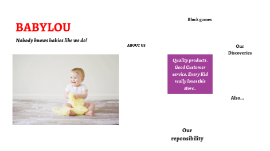
Transcript: Nobody knows babies like we do! Quality products . Good Customer service. Every Kid really loves this store.. BABYLOU ABOUT US About Us BabyLou was established in 2004. It has been more than a decade since we started, where we have ensured to take care of every need and want of every child and infant under one roof, true to the caption “NO BODY KNOWS BABIES LIKE WE DO”. Our benchmark is to provide 100% customer service and satisfaction and continue to deliver the same with a wide range of toys, garments and Baby Products. Play and Create We Are Best 01 02 03 Block games Building Blocks help Kids to use their brain. PLAY TO LEARN in Crusing Adventures Our Discoveries Enjoy a sunny vacation aboard a luxury yacht with the LEGO® Creator 3in1 31083 Cruising Adventures set. This ship has all the comforts you need, including a well-equipped cabin and a toilet. Sail away to a sunny bay and take the cool water scooter to the beach. Build a sandcastle, enjoy a picnic, go surfing or check out the cute sea creatures before you head back to the yacht for a spot of fishing. Escape into the mountains Disney Little Princes in Also available for your Babies..... Also... Out of The World… Our reponsibility BABYLOU…. Our Responsibility All children have the right to fun, creative and engaging play experiences. Play is essential because when children play, they learn. As a provider of play experiences, we must ensure that our behaviour and actions are responsible towards all children and towards our stakeholders, society and the environment. We are committed to continue earning the trust our stakeholders place in us, and we are always inspired by children to be the best we can be. Innovate for children We aim to inspire children through our unique playful learning experiences and to play an active role in making a global difference on product safety while being dedicated promoters of responsibility towards children.

Now you can make any subject more engaging and memorable