Lean Canvas Template
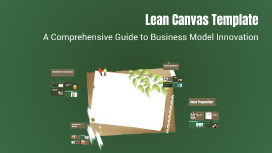
Transcript: Lean Canvas Template A Comprehensive Guide to Business Model Innovation Problem Identification Introduction to Lean Canvas Understanding Customer Pain Points Define the Problem The problem must be articulated clearly to ensure alignment of solutions with customer needs. Focus on specific issues rather than vague generalities, which can lead to misalignment in value propositions. Customer pain points can range from functional problems to emotional frustrations. Categorizing these pain points helps in determining where product improvements or new solutions may be required. Example Scenarios What is Lean Canvas? Prioritizing Problems Key Components Explained Consider a company facing high customer churn. Conduct root cause analysis to identify specific pain points such as poor customer service or product usability issues, which can then be addressed systematically. Not all problems are created equal; prioritization helps focus efforts on the most critical issues affecting customer satisfaction. Use techniques like the Impact vs. Effort Matrix for effective prioritization. Lean Canvas is a one-page business model framework derived from the Business Model Canvas. It focuses on addressing startup-specific challenges and helps entrepreneurs visualize and document their assumptions. Lean Canvas comprises nine segments: Problem, Solution, Key Metrics, Unique Value Proposition, Channels, Customer Segments, Cost Structure, Revenue Streams, and Unfair Advantage. Each segment is crucial for outlining the business's potential. Importance of Lean Canvas When to Use Lean Canvas The Lean Canvas promotes clarity by summarizing critical components of a business model on a single page. This aids entrepreneurs in quickly assessing the viability of their ideas and iterating based on feedback. The Lean Canvas is particularly beneficial during the early stages of a startup. Utilize it for brainstorming ideas, validating concepts, and preparing for investor discussions. Value Proposition Creating a Compelling Value Proposition Testing Viability of Value Proposition Testing the viability of a value proposition involves collecting customer feedback and validating assumptions. Techniques such as surveys, MVP testing, and iterative development are crucial for ensuring alignment with customer expectations. A compelling value proposition defines the unique benefits that a product or service delivers. It should articulate how it solves customer problems or improves their situation, resonating clearly with target audiences through clear messaging. Differentiation Strategies Real-Life Examples Key Metrics and Validation Differentiation strategies can include unique features, superior quality, or exceptional service that stand out in the market. Businesses must assess their competitors and identify unique attributes that influence customer decision-making. Successful companies like Apple and Dropbox exemplify effective value propositions that resonate with consumers. Apple's focus on innovation and seamless user experience, along with Dropbox's free storage and ease of use, differentiate them significantly in competitive markets. Methods for Validation Identifying Key Performance Indicators (KPIs) Validation methods, such as customer interviews and A/B testing, provide crucial data on product-market fit. These methods help refine business ideas by assessing real customer feedback and behavior. KPIs provide essential insights into business health. Common KPIs include customer acquisition cost, customer lifetime value, and churn rate, enabling businesses to track their effectiveness and adjust strategies accordingly. Feedback Loop Incorporation Iteration and Improvement Processes Integrating feedback loops ensures that customer insights inform product development. Regular check-ins with users through surveys or interviews can significantly enhance product adaptation and customer satisfaction. Continuous iteration based on feedback leads to improved products. By adopting an agile mindset, businesses can implement changes swiftly, ensuring alignment with dynamic customer needs and market conditions.

 Prezi Present

 Prezi Video

 Prezi Design